Lesson 2: John Brown, The Opera and the Story
Background
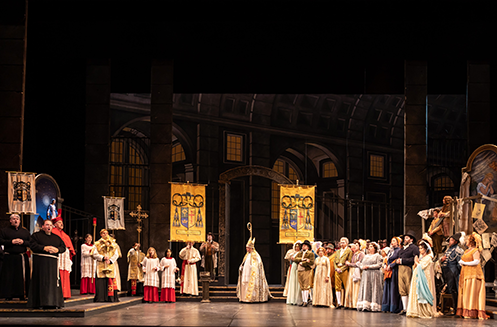
This lesson should be taught following Putting Yourself in the Picture. It introduces students to John Brown's life through examination of the libretto of the opera, John Brown.
If students have not discussed primary and secondary sources, this lesson will provide an opportunity for that discussion.
Primary source documents are those official documents from the time such as wills, letters, census records, diaries, newspaper articles, or other documents written by people who lived at the time and witnessed the events. Secondary documents are sources such as text books, novels, biographies, movies, operas, plays or other sources that draw on primary sources but may also reflect the opinions or biases of the authors. Secondary documents may be all that are available, but in using them care must be taken to understand the origin of the documents and the biases their authors may have had, as well as the relative accuracy of their sources.
You can share the example of information from a Website. Wikipedia can be edited by anyone, though it is often the first source many students go to for information. Errors have been noted and are corrected by the Website contributors and others, but prior to corrections, misinformation is available for people to access. Knowing about the site's ownership and the source of the information on the site is critical to understanding how much you can trust the information.
Objectives
Following this lesson, students will be able to:
- Identify critical events of John Brown's life;
- Compare the libretto story to the actual story;
- Trace the travels of John Brown;
- Create an accurate time line of the events of John Brown's life.
Materials
Butcher paper
Board or flip chart
Markers
John Brown Libretto
Timeline for John Brown's Life
Internet sites
Lyric Opera of Kansas City Website:
http://www.kcopera.org/About/johnbrowneducation/
PBS Website (map):
http://www.pbs.org/wgbh/amex/brown/maps/index.html
PBS Website or handout (timeline):
http://www.pbs.org/wgbh/amex/brown/timeline/index.html
Valley of the Shadow site:
http://valley.vcdh.virginia.edu/tour.html
Genealogy Website: (For Extension activity)
http://www.kancoll.org/articles/browns.htm
http://www.geocities.com/Heartland/Park/9580/jbfamily.html
Time
2 + class periods
Procedure
-
Introduce the lesson to the students. "You have finished thinking about a situation where there was no 'right answer' to a very difficult question. It involved laws and a person's reactions to a law that seemed unjust."
-
Say to students, "Today we will begin to look at an actual event in history that has the same conflict. John Brown was an important man in Kansas, Missouri, and U.S. history. What do you know about John Brown?" Allow students to report out what they know as you record the information on the board or a flip chart. Accept all answers whether they are correct or not. Save the list for later in the lesson.
-
Tell the students, "Among stories, plays, and songs written about John Brown, there has been an opera composed. We will use the opera to begin to examine John Brown's life. The words of the opera are called the libretto." Pass out copies of the libretto and have students read it. You can do this silently, individually, or you can assign parts and have students read it aloud in class. You may also assign the reading as homework prior to this lesson. Have students take notes on what they think are the most important parts of John Brown's life.
-
Discuss critical incidents as illustrated in the opera. Remind students that an opera is a story and does not have to be entirely accurate. They will begin to study John Brown through documents that accurately tell the story of his life. Some will be primary source documents and others secondary source documents.
-
Examine the PBS Website http://www.pbs.org/wgbh/amex/brown/timeline/index.html
You can duplicate copies of the site for each student or if you have access to a computer students can read it online. An additional resource is found at the end of this lesson. It is keyed to the map at http://www.kcopera.org/About/johnbrowneducation/.
Compare these highlights to those that students noted from the libretto. Fill in any missing events to complete a written timeline of John Brown's life. Note any conflicting information.
In preparation for the next part of the lesson, create a class timeline (diagram) using butcher paper. Make it large enough so that additional events can be added as your study continues. You may want to assign a group of students to create it or you can make the timeline and post it where students can continue to record information on it.
-
Go to the Kansas City Lyric Opera site (http://www.kcopera.org/About/johnbrowneducation) and/or return to the PBS site http://www.pbs.org/wgbh/amex/brown/timeline/index.html. Click on the "maps" on the left. You have a choice here of an interactive map site or the graphics and text version. If you have the ability to project a computer image, show the students the interactivity by pointing the cursor to one of the numbers on the map. Have them read the date and what happens at each of these times. If there is new information, have students add it to their own timeline of John Brown's life.
If you do not have projection capabilities, students can interact with the map in groups at computers or you can copy the information from the map with text for student use.
-
Divide the students into six groups. Assign a part of John Brown's life to each of the groups. These groups will become experts on a part of John Brown's life. Using the Map from the PBS site, you might want to assign the groups using these time divisions:
Group 1: Birth (1800) to 1848: Numbers 1-5 on the map
Group 2: From 1848 through 1856; Number 6 on the map
Group 3: 1857: Numbers 7-13 on the map
Group 4: 1858: Numbers 14-15 on the map
Group 5: January through August 1859: Numbers 16 - 17 on the map
Group 6: September through December 1859: Numbers 18-19 on the mapMaterials for research for the students can be found in the resources list. Primary sources can be found at both the PBS site, http://www.pbs.org/wgbh/amex/brown/ or at the Library of Congress site www.loc.gov Search for John Brown at these sites. Primary source documents can be found at the Valley of the Shadow site http://valley.vcdh.virginia.edu (Click "Enter the Valley Archives"). Specific documents related to John Brown are listed in the resources list at this site. Encourage students to check in their school and local library and to do online searches in order to fill in missing information that will tell them more about John Brown.
Some of the things you might prompt students to include are:
1) Important people in his life.
2) Events that seemed to influence his thinking about slavery.
3) Things that shaped his character and his understanding of his place in the world. When students have had enough time to gather information, they should write a brief summary of what they found and present it to the class. When it is appropriate, have them add these events to the class timeline. Let each group add events to their part of the timeline.
Review the timeline to see if everything of importance is there.
Go back to the list of things the students knew about John Brown. Identify the correct information and edit what you have found was incorrect.
Revisit the libretto to see if there are mismatches between the libretto and what you have found about John Brown's actual life. Identify those places and discuss artistic license. Why would an artist take liberties with facts as he or she presents a story? What would be the advantages or disadvantages to doing that? (This libretto is a fairly close representation of the events and sequence of John Brown's life. Students may not find many differences between the two sources of information.)
Extension
Students with a continued interest in John Brown's life may pursue this activity. John Brown was married twice and had a lot of children. Have the students examine the documents, "The Children of John Brown of Harpers Ferry" accessible from these two Websites: http://www.geocities.com/Heartland/Park/9580/jbfamily.html and http://www.kancoll.org/articles/browns.htm. Using the timeline, have students note the dates when John Brown's 20 children were born. While he was busy with his work and mission, his wives were likewise as occupied!
Students may make a genealogy chart of Brown's parents, his generation, and his children with information students now have about their spouses and children. They may also want to continue research to follow one of his children's families. Of course it would have to be one who did not die at Harpers Ferry!
John Brown is a common name. If students continue with their own searches, alert them to look for clues in the information that this is, in fact, the John Brown of Harpers Ferry. Even sites that claim to have information about Brown will have conflicting information. Use this as an opportunity to discuss how information from secondary sources must be confirmed from several other sources before we can trust its validity.
Students interested in history may want to investigate the sources of the conflict in Kansas arising out of the Missouri Compromise and the Kansas Nebraska Act.
Essay Contest
Encourage your students to participate in the Lyric Opera of Kansas City Essay Contest. You can find more about it by visiting www.kcopera.org/About/johnbrowneducation/essay.
Lesson created by Martha A. Henry and Keith S. Murray, M.A. Henry Consulting, LLC.
Web Version
PDF Version